
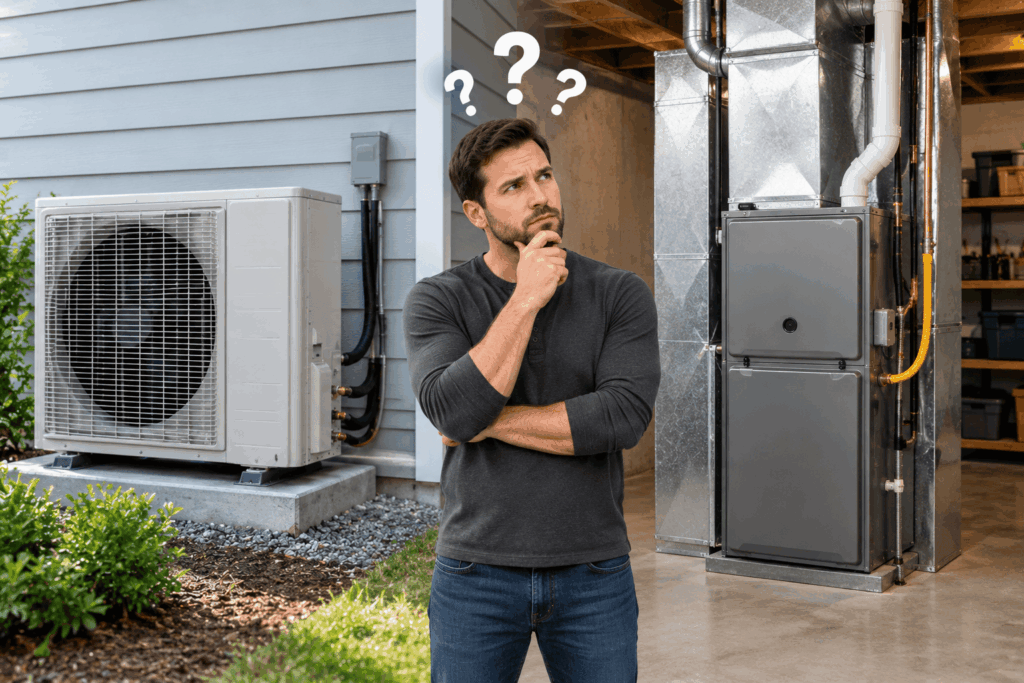
The boring reason most decisions about heating fail is that they are made backward. Homeowners choose a system based on a headline efficiency number or a neighbor’s recommendation, only to learn months later, often on the coldest night of the year, that the unit was never matched to their home’s true heat loss, ductwork, or climate exposure. What follows isn’t subtle: rooms that never quite reach setpoint, a compressor or heat exchanger working overtime until it fails early, and a utility bill that climbs steadily instead of settling into a predictable range. We’ve watched this pattern repeat enough times at Herdman Plumbing Heating & Cooling that we no longer start a consultation by pitching equipment; we start by asking questions that most comparison articles skip entirely.
This blog breaks down those questions in the order we actually ask them, with the technical detail usually left out of a heat pump vs furnace comparison, from the specific temperature where a heat pump’s output starts declining, to the sizing math that gets ignored, to when a hybrid setup outperforms either system running alone.
The Question That Matters More Than ‘Which System Is Better’
“Which is better” assumes every home faces identical conditions, and that assumption is exactly where sizing errors and comfort complaints begin. Two houses on the same street may require very different equipment, depending on the insulation, the condition of the ducts, and the number of hours in winter that the outdoor temperature is below freezing. The better question, first of all, has nothing to do with the equipment at all; it’s about the building and the climate around it.
The One Question We Ask First: “What Does Your Winter Actually Look Like?”
We ask homeowners to describe their coldest stretch, not their average winter day. A couple of nights near freezing doesn’t do what three weeks straight below freezing does, and that difference is what determines how much of the heating season a heat pump can realistically handle on its own before it needs help.
Why Climate Matters More Than Brand or Efficiency Rating
Manufacturer efficiency ratings are measured under specific lab conditions, and homeowners who shop by that number alone often end up disappointed once winter sets in for real. More important than any marketing claim are two figures: the coefficient of performance, or COP, and how that number changes as temperatures fall.
COP: The Number That Actually Tells the Story
COP measures how much heat a system delivers per unit of electricity it consumes; a COP of 3 means three units of heat for every one unit of power used. At a mild 47°F, most heat pumps run a COP between 3.0 and 4.5, covering heat pump vs furnace efficiency comfortably in their favor. That number generally drops to the 2.0-2.5 range as the outdoor air gets close to freezing. Standard units can come in at a COP of close to 1, no better than electric resistance heat, somewhere between -5°F and 0°F. Models for cold climates that use variable-speed compressors and enhanced vapor injection work considerably better: DOE Cold Climate Heat Pump Challenge testing found these units retained over 70% of their rated capacity at -15°F. The gap between a standard and a cold-climate unit is enormous, and it’s rarely disclosed on a sales flyer.
A heat pump that looks “highly efficient” on paper can still leave a home cold if its COP was never tested against your coldest design day.
The Temperature Threshold Where Heat Pumps Start Struggling
There isn’t one universal cutoff, but the pattern is consistent: capacity and efficiency both decline as the lift between outdoor air and indoor setpoint widens. Standard heat pumps begin noticeably losing ground in the low-to-mid 30s°F, and by the time temperatures fall into single digits, many are leaning heavily on backup heat strips just to hold the thermostat’s setpoint, which is where electric bills spike unexpectedly. Skipping this analysis is one of the most common heat pump sizing mistakes we see corrected after the fact, usually after a homeowner has already suffered through a winter of cold mornings and a bill that didn’t match expectations.
The Second Question: “What’s Already in Your Walls and Ducts?”
Climate aside, existing infrastructure often decides what’s realistic without a costly overhaul. Before we make any recommendations, we look at the following:
- Whether ductwork already exists, and whether it’s sized correctly for the equipment being considered
- The condition of that ductwork, since leaks quietly rob either system of performance
- The home’s electrical panel capacity, since heat pumps run entirely on electricity
- Whether gas service is already run to the property
A house with tired, undersized ducts is going to underperform with either system until that’s addressed first. No new furnace or heat pump fixes a duct problem underneath it.
The Third Question: “Are You Trying to Cut Your Bill, or Cut Your Carbon Footprint?”
These two goals don’t always lead to the same recommendation. Homeowners focused purely on heat pump vs furnace cost over the system’s lifespan may lean toward whichever fuel source is locally cheaper and more stable, while homeowners prioritizing electrification accept a different cost profile to reduce fossil fuel use. The honest answer to whether a heat pump is better than a furnace depends entirely on which of these two outcomes matters more to the household asking.
Could a Hybrid System Split the Difference?
For many homes, the smartest answer isn’t either system alone; it’s a dual-fuel system heat pump furnace setup, where the heat pump carries the load through milder weather and the furnace takes over automatically below a set “balance point,” typically somewhere between 30°F and 40°F depending on the home and fuel costs. The hybrid heating system pros and cons discussion generally boils down to this: homeowners get efficient electric heat the bulk of the season, with reliable backup just when the heat pump’s output would otherwise be lacking, without gambling comfort on a single system handling the entire winter.
How We Make the Final Call
This is where many of the industry’s shortcuts do real damage. The old contractor rule of “500 square feet per ton” routinely results in equipment that is 20-40% oversized. An oversized system short-cycles, does not control humidity, and wears out its compressor years ahead of schedule. We size every recommendation using an actual room-by-room load calculation rather than a square-footage guess, which is the single biggest factor in how to choose between a heat pump and furnace correctly the first time. Combined with the climate, infrastructure, and cost priorities already discussed, this is how a final recommendation comes together, built around the specific house, not a generic chart.
Getting Your Heating Question Answered the Right Way
There’s a place for a furnace, heat pump, or hybrid system; the mistake is not choosing the “wrong one” in the abstract, but ignoring the questions that reveal which one actually fits a particular home’s climate exposure, ductwork, electrical capacity, and priorities.
At Herdman Plumbing Heating & Cooling, we’ve built our heating consultations around exactly this process for homeowners throughout Western Washington, including Gig Harbor, Silverdale, Bremerton, Bainbridge Island, Poulsbo, and Port Orchard. Every recommendation we make is backed by a proper load calculation and an honest look at what your home already has in place, not a one-size-fits-all sales pitch.
If your current system has already let you down once this season, don’t wait for it to fail again on the coldest night of the year. Call 360-698-4147 to schedule a consultation with our team.