
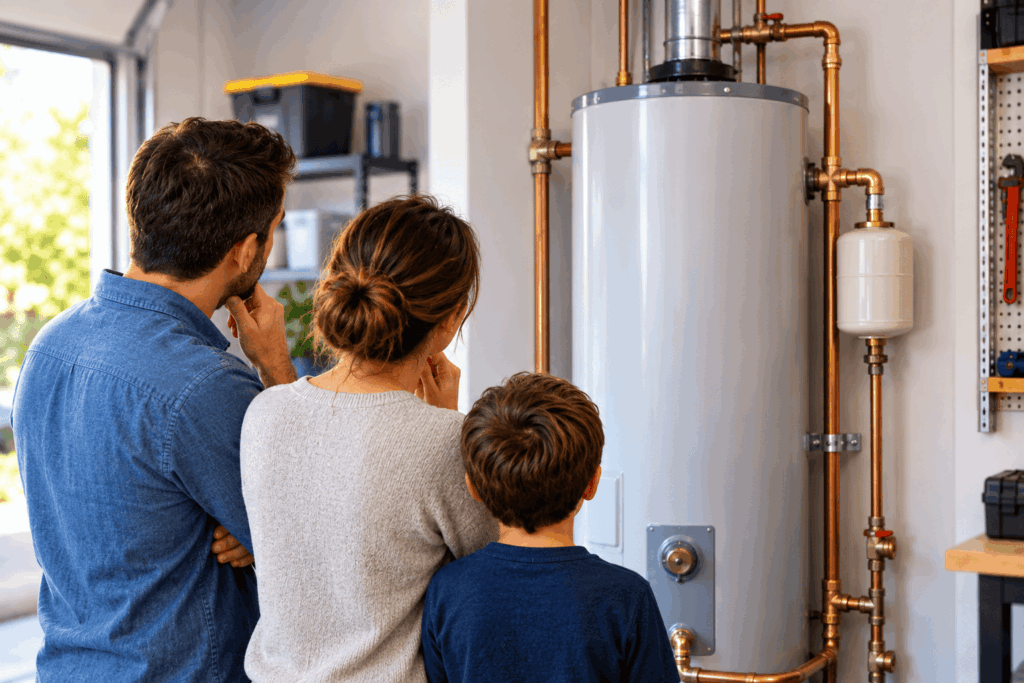
Most hot water complaints get blamed on an “old” or “faulty” unit, when the real issue was decided the day it was installed. Water heater sizing is a calculation, not a guess, and skipping it means the tank or tankless unit in your home works against your household from day one. An undersized system doesn’t just run cold once in a while if left uncorrected. It runs harder, wears out faster, and fails before its expected lifespan. At Herdman Plumbing Heating & Cooling, our technicians calculate this before recommending equipment, because a properly sized unit is the difference between a system that lasts and one that gets replaced twice as often.
This water heater size guide covers why sizing goes wrong, the warning signs of a mismatch, and how our team actually calculates what size water heater you need for a given household, plus a mechanical issue unique to tankless systems that most sizing guides skip entirely.
What Water Heater Sizing Actually Means And Why Most Homeowners Get It Wrong
Sizing a storage tank comes down to one number: the First Hour Rating, printed on the EnergyGuide label, showing how many gallons of hot water a full tank delivers in its first hour, tested under Department of Energy protocol. Tankless units are sized differently, by flow rate in gallons per minute.
Homeowners make the almost universal mistake of thinking that tank capacity is the only thing that matters. Depending on recovery rate, two 50-gallon tanks may be very different in performance. A tankless unit rated for one bathroom will be taxed the minute a second fixture opens. Sizing needs to be based on actual water pulling, not just how much water is stored.
The Telltale Signs Your Water Heater Is the Wrong Size
A mismatched unit rarely fails outright at first; it shows up as a pattern of small frustrations homeowners tend to blame on age rather than sizing.
Running Out of Hot Water Mid-Shower
A common water heater sizing mistake is when the last person showering consistently gets cold water, meaning the tank’s First Hour Rating has fallen below your household’s peak hour demand, especially if the household has grown since it was installed.
Sky-High Utility Bills With Barely Any Usage Change
A tank that is too small is always playing catch-up to demand, while a tank that is too big wastes energy maintaining standby heat that never gets used. Either way, you wind up on the bill before anybody catches a comfort problem.
Long Wait Times for Hot Water to Reach the Tap
If your water heater takes too long to heat up between back-to-back uses, or hot water is slow to reach distant fixtures, recovery rate is usually the bottleneck, not the distance the water travels.
An undersized water heater doesn’t fail gracefully; it fails on a schedule, usually years before it should.
How We Actually Calculate the Right Size for a Household
Before you get a unit, we do a peak hour demand calculation: total gallons your household uses in the busiest hour, but based on the Department of Energy’s standard methodology and not some guesstimate. That means adding up the draw of every fixture likely to be running at the same time- showers, dishwasher, a laundry cycle- and comparing it against a tank’s First Hour Rating or a tankless unit’s rated GPM.
We also weigh water heater recovery rate into the equation, since a standard 40,000 BTU gas burner recovers roughly 40 to 45 gallons per hour at a 90°F temperature rise, while a comparable electric element manages closer to 18 to 21 gallons per hour. Two tanks of the same size can require very different follow-up plans once you factor in recovery, and sediment buildup just widens that gap; mineral deposits insulate the burner or element from the water above it, quietly dragging down recovery rate over the years even when nothing in the household has changed.
The Sizing Mistake We See Most Often on Service Calls
Across our service calls, the same sizing errors keep resurfacing, and in nearly every case, the homeowner inherited the problem rather than caused it.
Replacing Like-for-Like Without Checking Household Changes
When a tank fails, swapping in an identical replacement is the fastest fix. If the household has grown or added a bathroom since the original install, that replacement ensures the same shortfall comes back on a predictable timeline.
Builder-Grade Installs Sized for the Smallest Acceptable Cost
New construction is frequently fitted with the smallest tank that satisfies code, not the size suited to how a family will actually live in the home, a leading reason newer builds still report cold showers after washing dishes.
Ignoring Simultaneous Demand (Showers + Dishwasher + Laundry)
The problem is that sizing based on one fixture doesn’t account for what happens when several draws stack up in the same hour, which is precisely what peak hour demand calculations are designed to capture.
Tank vs. Tankless Water Heater – Does Sizing Work the Same Way?
The sizing logic is very different between a tank and a tankless system, and if you get it wrong, you get a very specific, well-documented symptom, not some vague comfort complaint.
The Cold Water Sandwich Effect Few Homeowners Are Warned About
An undersized or improperly sized tankless unit can create what is called the “cold water sandwich” in the industry, a burst of cold water between two stretches of hot water that happens because of the short delay as the heat exchanger catches up to demand. Flow rates less than about 0.4 to 0.5 gallons per minute can keep the burner from lighting in the first place. An undersized gas line only makes a bad situation worse, starving the unit of the fuel it needs to achieve its rated output.
Why Tank vs Tankless Water Heater Cost Isn’t the Only Factor
The tank vs tankless water heater cost conversation usually centers on upfront investment, with tankless units typically costing more to install. But the cost alone does not address the sizing question. The properly sized tankless system will give you truly continuous hot water, while an undersized system, no matter what the cost, will still produce the cold water sandwich effect that the tankless vs traditional water heater comparison needs to include.
| Factor | Tank | Tankless |
| Sizing metric | First Hour Rating (gallons) | Flow rate (GPM) |
| Runs out under heavy demand | Yes, once tank drains | No, but can’t exceed rated GPM |
| Common sizing failure | Slow recovery, cold showers | Cold water sandwich effect |
| Affected by sediment/scale | Recovery rate declines | Flow and output decline |
How to Know If Your Current Water Heater Is Sized Correctly
A few checks reveal whether your current setup matches your household before calling anyone out:
- Track your busiest hour. Note whether hot water thins out during your heaviest overlap of showers, laundry, and dishes.
- Check the EnergyGuide label. Compare the tank’s First Hour Rating against your estimated peak demand.
- Watch recovery between uses. If your water heater recovery time is too slow to keep pace between consecutive showers, the unit is likely undersized.
- Note household changes. A returning student, a new baby, or an added bathroom can shift peak demand well past what the existing unit was built to handle.
If your setup fails more than one of these checks, the fix is a sizing verification, not another year of staggered shower schedules.
Getting Your Household’s Hot Water Sized Right, the First Time
Sizing a water heater is not about settling for what was there but rather matching the real household demand, recovery rate, peak hour draw, and simultaneous use to a tank’s First Hour Rating or a tankless unit’s flow rate. That’s a system that does not fit together, which means utility bills go up, gear ages faster than it should, and a failure that will eventually happen on its own timeline, not yours.
Herdman Plumbing Heating & Cooling has been calculating and correcting exactly this kind of sizing mismatch for households across Silverdale, Bremerton, Gig Harbor, Bainbridge Island, Poulsbo, Port Orchard, and the surrounding Kitsap County area since 2005. Our team walks through the peak demand numbers with you directly, whether that points to a properly matched tank or a tankless system built for your home’s actual simultaneous use, and we install and service both.
If your household is already living with the warning signs above, waiting rarely improves the outcome. Call Herdman Plumbing Heating & Cooling at 360-698-4147 to get your home’s hot water needs sized correctly before the current unit forces the decision for you.