
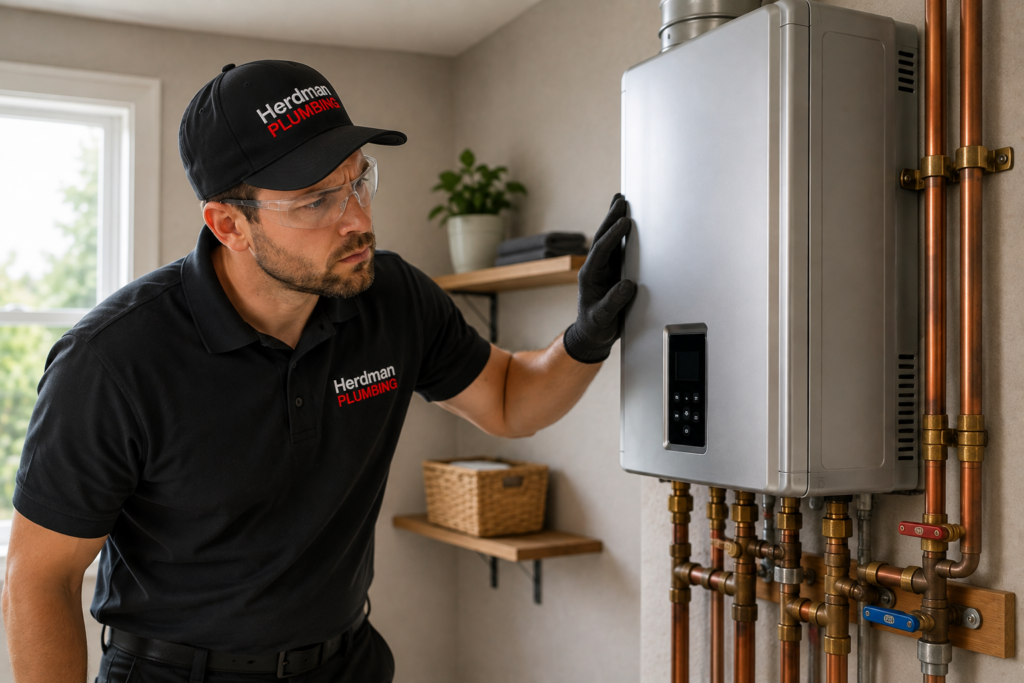
Most homeowners never learn how a tankless water heater actually decides how much hot water to give them, and that gap in understanding is exactly why so many systems underperform. The unit isn’t simply “on” or “off.” It’s based on a formula of flow rate and temperature rise, and when either number strays from what the system was designed for, efficiency quietly collapses in the background, and your bill goes up. If left unchecked, this mismatch won’t correct itself; instead, it speeds up wear and tear on internal parts, reduces the lifespan of the equipment, and eventually results in an unscheduled tankless water heater repair that could have been prevented completely.
At Herdman Plumbing Heating & Cooling, we’ve spent years diagnosing exactly this problem for homeowners who did everything “right” and still aren’t seeing the return they expected.
This blog breaks down the actual engineering behind why tankless systems underperform, not the surface-level explanations you’ve probably already read. We’ll discuss the flow-rate math manufacturers use, why groundwater temperature makes all the difference, and what specific maintenance failures quietly erode at tankless water heater efficiency month after month.
Are Tankless Water Heaters Supposed to Lower Utility Bills?
Yes, but the mechanism behind those savings is more precise than most people realize. A tankless water heater only heats water the moment it’s requested, using a formula that multiplies flow rate by temperature rise to determine required output. Get either variable wrong, and the projected tankless water heater savings never materialize.
Here’s the part almost nobody explains: the industry uses a specific calculation, BTU/h equals 500 multiplied by GPM multiplied by temperature rise, to determine exactly what a unit can deliver. That “500” isn’t arbitrary. It’s based on the physical properties of water itself. So the math behind your hot water is more of a science formula than a sales spec sheet.
Common Reasons Your Tankless Water Heater Costs More Than Expected
Incorrect System Sizing
Sizing isn’t a matter of picking a bigger box for a bigger house. For a four-person household, a peak capacity of 8 to 10 GPM is needed to run a dishwasher, shower, and washing machine at the same time. An undersized unit will run on throttle until the temp drops; an oversized unit will cycle inefficiently for smaller draws.
High Hot Water Demand During Peak Hours
Every tankless unit has a maximum BTU ceiling. When your household stacks multiple fixtures at once, morning showers overlapping with a running dishwasher, the combined demand can exceed what the unit was built to deliver simultaneously, forcing a drop in either flow or temperature.
Poor Installation That Reduces Efficiency
Tankless water heater installation errors rarely show up on day one. They show up months later as slowly degrading performance, because the unit is compensating for some deficiency, such as a restricted line or undersized gas connection, that was engineered into the system from the start.
One formula explains almost every complaint we hear about tankless performance: BTU/h = 500 × GPM × temperature rise. Everything else is a symptom of getting one of those three numbers wrong.
Hidden Factors That Affect Energy Savings
The single biggest hidden variable in tankless performance isn’t the unit itself; it’s the temperature of the water entering your home. Here’s why that matters more in our region than almost anywhere else in the country:
| Region Type | Typical Winter Groundwater Temp | Required Temperature Rise to 120°F |
| Southern U.S. | 60–75°F | 45–60°F |
| Mid-Atlantic | 50–60°F | 60–70°F |
| Pacific Northwest | 42–50°F | 70–78°F |
A unit rated to deliver a strong flow rate in a warmer climate can lose a significant share of that capacity once it’s asked to produce a 70°F-plus rise, which is the reality for most homes served in our region during the coldest months. That’s why sizing recommendations from a national retailer or an online calculator designed for another climate zone can leave you short.
Installation Mistakes That Can Reduce Long-Term Savings
Every one of the following mistakes has the same signature: the unit runs, but never at the efficiency that it was rated for.
Choosing the Wrong Fuel Type for Your Home
Gas units built for whole-home use draw far less electrical load than their electric counterparts; some electric tankless systems require well over 100 amps of dedicated service, a demand many residential panels simply weren’t built to support. If you are locking in the wrong fuel into your electrical infrastructure, you are locking in inefficiency before the unit even runs its first cycle.
Improper Venting and Gas Line Sizing
Gas-fired tankless units require venting and gas lines that are sized to their specific BTU draw. If the gas line is undersized, the burner is starved for fuel at peak demand, and the unit has to work harder for a smaller temperature gain.
Skipping Manufacturer-Recommended Setup
Manufacturer specifications exist because they were tested against real-world flow and temperature conditions. Skipping even one recommended step, such as placing isolation valves for future service, can subtly undermine the system’s long-term performance and future maintenance.
Maintenance Issues That Quietly Increase Operating Costs
Why Annual Descaling Matters
Mineral scale acts as an insulator within the heat exchanger, causing the unit to use more energy to move the same amount of heat. Left unaddressed, scale buildup can restrict flow below the roughly 0.4 to 0.5 GPM threshold most units need just to activate, which is what triggers the sudden cold bursts homeowners often mistake for a broken unit. Tankless water heater descaling on a consistent schedule is what keeps that threshold protected.
Cleaning or Replacing Water Filters
A clogged inlet filter restricts water before it ever reaches the heat exchanger, and the unit compensates by running longer to hit the same output. This one missing ingredient is responsible for a large share of the performance problems we investigate.
Inspecting Components Before Small Problems Become Expensive Repairs
A worn gasket or a minor sensor drift rarely causes a total shutdown right away. Instead, it produces small, gradual inefficiencies that are easy to miss until they compound into a full system failure, cutting short what should be a tankless water heater lifespan of fifteen to twenty years.
How Your Household Habits Affect Tankless Water Heater Efficiency
Your daily habits interact directly with the flow-and-rise formula that governs your unit. If you run back to back showers, or the dishwasher in the middle of a laundry cycle, or a faucet left at a slow trickle for a long period of time, you pull the system out of the efficient operating range it was designed for, even if there is nothing mechanically wrong.
Simple Changes That Can Improve Your Savings
- Stagger high-demand fixtures instead of running them simultaneously.
- Insulate exposed hot water lines to reduce heat loss over long runs.
- Install a whole-home water softener if you’re in a harder water area.
- Keep to a consistent annual descaling and filter-cleaning schedule.
- Consider a recirculation loop if wait times at distant fixtures are excessive.
When Your Tankless Water Heater May Need Professional Attention
Rumbling or “kettling” sounds are often signs of scale build-up so bad that immediate de-scaling is required. Repeated cold bursts unrelated to normal cycling, visible error codes, or a noticeable rise in energy use without a change in household habits are all signs the system needs a trained diagnosis rather than a guess.
What Your Tankless System Is Actually Telling You
Once you get it, there’s nothing mysterious about the math behind tankless performance: flow rate, temperature rise, and consistent maintenance determine everything from your monthly bill to the number of years the unit lasts. Skipping proper sizing, cutting corners on tankless water heater installation, or falling behind on tankless water heater maintenance doesn’t just risk comfort; it guarantees a shorter equipment lifespan and higher operating costs that compound with every season you wait to address them.
At Herdman Plumbing Heating & Cooling, we apply this same technical approach to every tankless vs traditional water heater conversation we have with homeowners, walking through real flow-rate and temperature-rise calculations rather than generic sizing charts. Whether you need precise water heater installation Silverdale planning, dependable water heater installation Bremerton service, or a straightforward water heater installation Belfair consultation, our team designs the system around your home’s actual groundwater conditions and household demand, not a one-size-fits-all estimate.
If your tankless system isn’t performing the way it was promised, the underlying cause is almost always fixable, but it rarely resolves on its own. Schedule a professional evaluation today at 360-698-4147 before a minor inefficiency turns into a costly repair.