
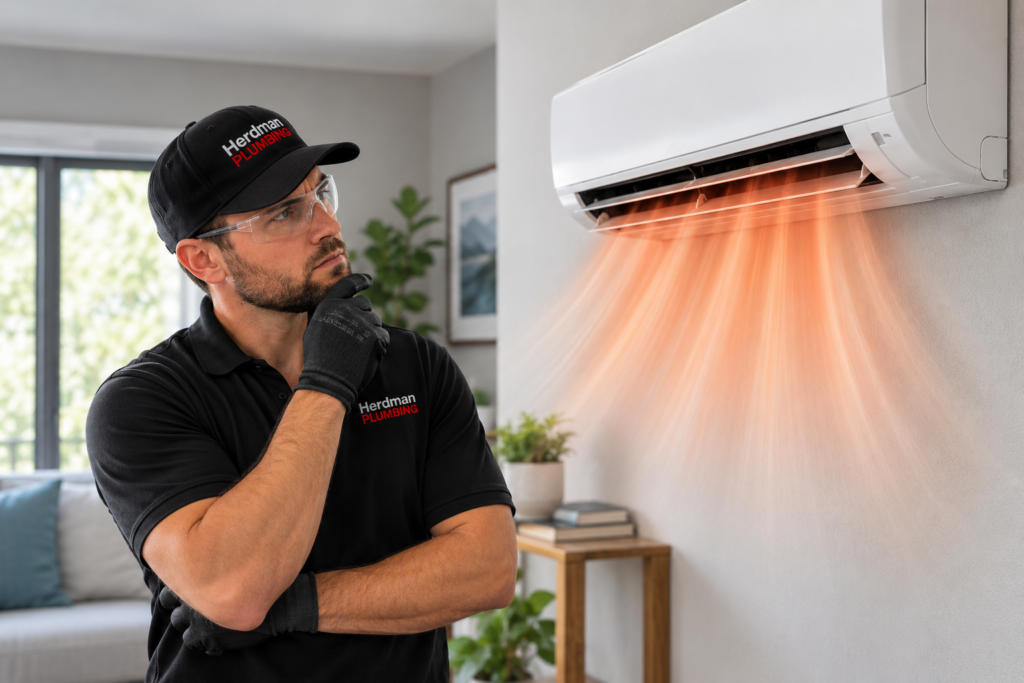
Warm air blowing out of a system that’s set to cool is not a minor inconvenience you can ride out. It’s a mechanical indicator that something inside your unit has already changed, whether that’s a valve that didn’t change position or refrigerant falling below the level your system was designed to run on. If left alone, it will never stay this size. It will grow into compressor strain, higher energy draw, and eventually a repair bill that could have been avoided with an earlier fix. That’s exactly where Herdman Plumbing Heating & Cooling steps in, diagnosing the real mechanical cause instead of guessing at it.
This guide breaks down the actual engineering behind a mini split blowing warm air, including the component most homeowners have never heard of but is often the true culprit. You’ll find out what constitutes an easy fix versus a major problem, what the research says about how fast performance degrades, and when to call a technician rather than keep trying to fix it yourself.
Is It Really Blowing Warm Air? Start with These Quick Checks
Before diagnosing a mechanical fault, it’s worth confirming the basics weren’t accidentally changed. A surprising number of service calls for a mini split not cooling trace back to something as simple as a wrong mode setting.
Run through these before assuming the worst:
- Mode selection: Verify the display actually shows “Cool” rather than “Heat,” “Dry,” or “Fan Only”
- Set temperature: The target must sit below current room temperature, or the compressor won’t engage
- Remote signal: Weak batteries can misfire a command without displaying an obvious error
- Breaker status: A tripped breaker to the outdoor condenser stops cooling entirely, even if the indoor unit powers on
Once these are ruled out and warm air is still coming through the vents, it’s pretty much always a mechanical problem, not something you accidentally set wrong.
The Most Common Reasons a Mini-Split Blows Warm Air
The reversing valve is the part that causes most of the warm air complaints when the unit is in cooling mode, and most homeowners have never heard of it. This is a four-way valve, controlled by an electromagnetic solenoid, that physically changes the direction of refrigerant flow depending on whether your system is heating or cooling. If the solenoid loses power or debris jams the internal slide, the valve can stick in the wrong position, and your system keeps trying to cool when refrigerant is being routed as if it were heating.
| Cause | What Happens Internally | What You’d Notice |
| Reversing valve stuck | Refrigerant flow directed incorrectly despite correct mode setting | Both refrigerant lines feel warm instead of one hot, one cold |
| Refrigerant undercharge | Reduced refrigerant mass limits heat absorption capacity | Weak, inconsistent, or gradually worsening cooling |
| Dirty filters or coils | Airflow restriction lowers heat exchange efficiency | Cooling feels weaker the longer the unit runs |
| Failing compressor | Refrigerant can’t be properly pressurized and cycled | System runs constantly without reaching set temperature |
| Blocked outdoor unit | Heat can’t be released outside, backing up the whole cycle | Warm air indoors paired with a hot, overworked outdoor unit |
A stuck reversing valve can make a perfectly charged, mechanically sound system blow warm air for weeks before anyone realizes the valve, not the refrigerant, is the actual problem.
Why Your Mini-Split Cools Sometimes but Not Consistently
A unit that cools fine one afternoon and struggles the next is often dealing with a fault that hasn’t fully developed yet, which is more common with mini-split cooling problems than most homeowners realize.
Laboratory testing on refrigerant charge faults offers a useful window into how gradual this decline can be. Field research has shown that even a small 10 percent undercharge will cause a measurable reduction in cooling capacity and efficiency, with the losses becoming much more severe as the charge approaches the 20-to-30 percent range. Practically speaking, that means your system does not crash all at once; it slides.
| Refrigerant Level | Approximate Capacity Impact |
| Slight undercharge (10%) | Noticeable capacity and efficiency loss |
| Moderate undercharge (20%) | Capacity can drop by roughly a quarter |
| Severe undercharge (30%+) | Sharp, compounding losses to both capacity and efficiency |
That inconsistency you’ve noticed isn’t random. It’s a measurable curve, and it only moves in one direction without intervention.
What You Can Safely Troubleshoot Before Calling an HVAC Technician
A handful of maintenance steps fall safely within a homeowner’s ability to handle, and taking care of those first can eliminate the simplest causes before calling for a visit.
Clean or Replace the Air Filters
Restricted airflow from a dirty filter forces the coil to work against reduced volume, which mimics the symptoms of a refrigerant problem without actually being one. Rinsing or replacing filters every few weeks during peak season keeps this variable out of the equation entirely.
Inspect the Outdoor Unit for Debris
Grass clippings, leaves, and dust collect around the condenser fins and block the heat-rejection process the whole system depends on. This will create approximately two feet of open space and will allow for normal airflow to occur without the risk of damaging the fins. If you notice any debris on the fins, you can also gently brush that away.
Reset the System and Monitor Performance
Turning the unit off at the remote and at the breaker for several minutes can clear a temporary control-board glitch that mimics a mechanical failure. The issue was probably electronic, not physical, if performance returns to normal and stays normal for the next hour.
Signs It’s Time to Schedule Professional Mini-Split Repair
Some symptoms are beyond the scope of a homeowner’s troubleshooting capabilities, requiring licensed diagnostic tools, especially anything involving sealed refrigerant lines or electrical components.
- Ice visibly forming on either the indoor or outdoor unit.
- A hissing or bubbling sound near refrigerant lines.
- Energy bills climbing without a change in usage habits.
- Warm air persisting even with clean filters and a clear outdoor unit.
- Water pooling beneath the indoor unit.
Mini split maintenance keeps this decline from adding up. The difference between a routine adjustment and a system already under strain catching a small loss of refrigerant is the ten percent stage and the thirty percent stage.
Can a Mini-Split Lose Cooling Efficiency as It Ages?
Yes, and the decline is measurable rather than anecdotal. Components like the compressor, coils, and reversing valve accumulate wear with every cycle, and refrigerant lines can develop micro-leaks over years of thermal expansion and contraction. Most well-maintained systems perform reliably for ten to fifteen years, but that window shrinks considerably for units that never receive scheduled service.
Consistent mini split maintenance interrupts this decline before it compounds. Catching a small refrigerant loss at the ten percent stage, rather than the thirty percent stage, is the difference between a routine adjustment and a system already under significant strain.
Tips to Keep Your Mini-Split Cooling Efficiently All Summer
A few consistent habits go a long way toward preventing the faults described above from ever developing into full breakdowns.
- Schedule mini-split service and maintenance annually, ideally before peak cooling demand begins.
- Keep at least two feet of clearance around the outdoor condenser at all times.
- Rotate or clean filters regularly instead of waiting for build-up to be visible.
- Avoid setting temperatures dramatically below room temperature, which forces unnecessary compressor strain.
- Address unusual sounds or smells immediately rather than monitoring them over time.
Protecting Your Comfort Before Warm Air Becomes a Bigger Problem
A mini split blowing warm air is rarely a mystery once the mechanics behind it are understood. Whether it is a reversing valve stuck in the wrong place or refrigerant that has quietly leaked out below its intended charge, the pattern is the same: small problems get bigger the longer they run without being noticed, and the data on refrigerant loss makes that decline easy to chart.
Our team at Herdman Plumbing Heating & Cooling brings that same diagnostic precision to every service call, offering HVAC mini split repair built on identifying the actual mechanical cause rather than guessing at symptoms. Homeowners across our service area, including those requesting air conditioning repair in Bremerton, air conditioning repair in Silverdale, and air conditioning repair in Bainbridge Island, rely on us for the same thorough approach to every mini-split we inspect.
If your system has been running warmer than it should, don’t give the fault more time to spread into the compressor or refrigerant lines. Call us today at 360-698-4147 to schedule your mini-split repair, and let our technicians restore reliable cooling before the next heat wave puts your system further to the test.