
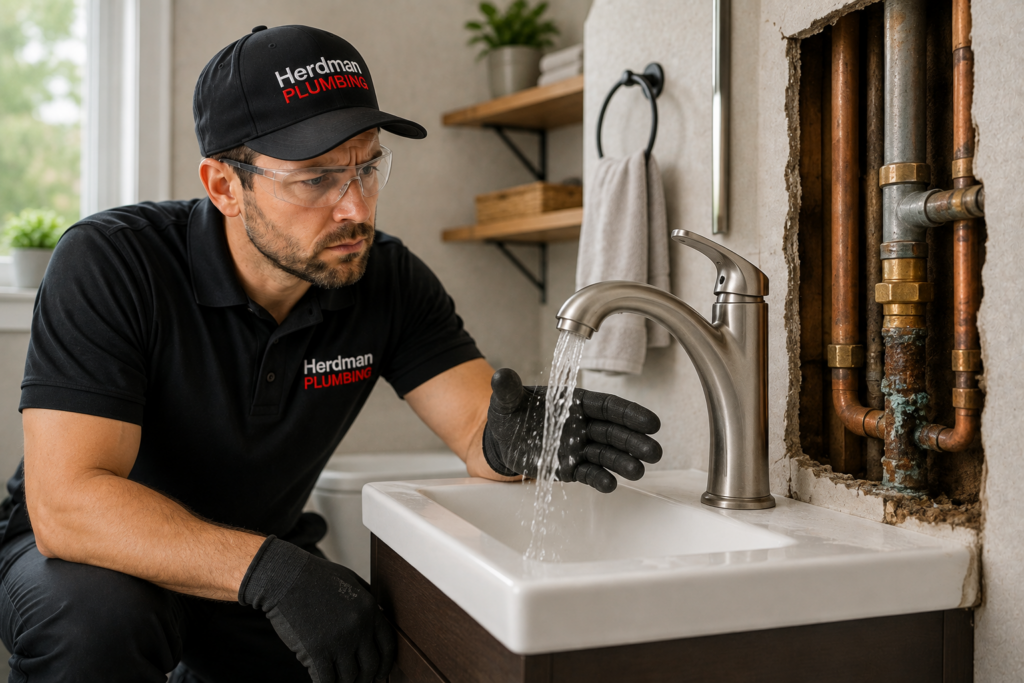
A change in water pressure is never simply a change in water pressure. It is the external expression of a mechanical process already happening inside your walls or underground, whether it’s corrosion that is narrowing a pipe from the inside or a leak that is quietly draining volume before you ever noticed anything wrong. Left alone, these processes don’t pause or reverse; they progress until a manageable fix turns into a structural repair, and by then the damage is no longer confined to a single pipe. Our team at Herdman Plumbing Heating & Cooling exists to catch that process at the stage where it’s still a simple correction.
This guide goes beyond the normal pressure checklist and explains the actual mechanics behind water pressure problems, including a corrosion process most homeowners have never named. You’ll learn what pressure symptoms mean, how professionals verify a diagnosis, and what happens, in real terms, if the signs are ignored.
Why Water Pressure Changes Should Never Be Ignored
Your plumbing system is designed to maintain pressure within a certain range. If it goes outside of that range, then something in the system has already failed or is in the process of failing. It’s not a matter of degree; it’s a binary signal that the mechanism regulating your water supply is no longer doing its job properly.
Most residential systems are built to run between 40 and 80 PSI, with 45 to 60 PSI considered the healthy working target by plumbing professionals. A reading that sits persistently above or below that band means either a regulating device has failed or a restriction has formed somewhere along the line, and neither condition improves without intervention.
A single pinhole leak, smaller than the head of a pin, can waste roughly 250 gallons of water a day while remaining completely invisible behind drywall for months. That statistic alone explains why pressure changes deserve immediate attention rather than a wait-and-see approach.
Hidden Plumbing Problems That Can Affect Water Pressure
There are three distinct mechanical processes that account for the vast majority of pressure complaints, and each one develops through a completely different pathway in your plumbing. Knowing which one is at work changes the diagnosis and urgency.
Undetected Pipe Leaks Behind Walls or Underground
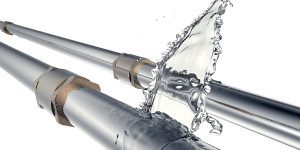
A supply-line leak rarely announces itself with a puddle. Rather, it steals volume before water ever reaches your fixtures, first as a reduction in pressure, and later as visible damage, after a leak has had time to saturate drywall, subfloor, or soil around a buried line.
Copper pipes are particularly susceptible to a failure mode called erosion corrosion, in which high-velocity water physically erodes the interior surface until the wall becomes thin enough to perforate. However, the resulting pinhole leaks are notoriously slow, so the loss of pressure you’re experiencing today might be indicative of damage that’s been developing for months or even years.
Mineral Buildup Restricting Water Flow
Hard water carries dissolved calcium and magnesium that settle onto pipe walls rather than passing through harmlessly. Once this scale starts to form, it builds up layer by layer and more quickly in pipes that already have some corrosion, because mineral deposits stick more easily to a rough, rusted surface than to a smooth one.
The result is a pipe that appears structurally sound on the outside while its usable interior channel has quietly shrunk. Mineral deposits in pipes rarely cause a dramatic symptom, but instead a slow and almost imperceptible decline that many homeowners accept without realizing something is wrong.
Aging or Corroded Water Supply Pipes
Galvanized steel supply lines are still found in many homes built before the 1960s, which fail by a process called tuberculation rather than just breaking. The zinc coating that protected the steel is worn away, allowing the metal to rust from the inside and forming rough, moundlike deposits on the interior wall.
| Pipe Material | Typical Service Life | Failure Pattern |
| Galvanized steel | 20 to 50 years | Internal tuberculation, gradual flow restriction |
| Copper | 50-plus years | Pinhole leaks from erosion or water chemistry |
| Brass | Up to 70 years | Slow degradation, generally more resilient |
What makes tuberculation particularly deceptive is that the exterior of the pipe can look entirely intact while the interior diameter has narrowed dramatically. Often, the first indication of this process is a loss of pressure, which happens a long time before any visible leak or discoloration is observed.
What Different Water Pressure Symptoms Can Tell You
The pattern and direction of a change in pressure greatly limit the probable cause and save much diagnostic time in reading these signals correctly.
| Symptom | Likely Cause |
| Gradual decline over several months | Mineral buildup or early tuberculation |
| Sudden drop with no clear trigger | A newly developed supply-line leak |
| Strong at one fixture, weak at another | Localized restriction or partial blockage |
| Sustained readings above 80 PSI | Failing pressure-reducing valve |
| Banging or shuddering pipes | Water hammer from unregulated pressure surges |
| Rust-tinted water after sitting overnight | Advanced internal corrosion |
High water pressure is often mistaken for a sign of a healthy system, when in reality it places constant, compounding stress on every seal, joint, and appliance connection in your home. If not checked, this type of pressure will eventually force a failure at the weakest point in the system, whether that is a supply hose, fitting, or a water heater connection.
The Long-Term Cost of Ignoring Water Pressure Problems
None of these processes stabilize on their own. A pinhole widens under continuous pressure. Every gallon that goes through thickens the mineral scale. Each year, tuberculation continues to develop further along the inner wall. What starts off as a manageable limitation will eventually become a more serious variation of the same failure.
Delaying action typically converts a contained, single-point repair into a much larger one. A pipe that could have been patched becomes one requiring full section replacement. A pressure-reducing valve that only needed recalibration fails outright and damages appliance seals on its way out. Plumbing problems that are caught early stay small; the ones that are rarely do.
How Professional Plumbers Diagnose Hidden Water Pressure Issues
It takes more than one hose bib gauge reading to confirm the true source of a pressure change. Our technicians will normally use a number of different diagnostic methods to establish precisely where and why there is a loss of pressure.
- Static and dynamic pressure testing: Comparing readings with fixtures idle versus running to reveal volume loss under demand
- Camera inspection: Feeding a scope directly into supply lines to visually confirm tuberculation, scale, or blockages
- Acoustic leak detection: Using sound-based equipment to locate leaks behind walls or underground without unnecessary excavation
- Pressure-reducing valve verification: Confirming the valve is holding its calibrated setting rather than drifting silently out of range
This layered approach is what makes accurate plumbing leak detection possible, letting our team target the actual point of failure instead of recommending a broad repair based on guesswork.
Simple Checks Homeowners Can Do Before Calling a Plumber
There are a few things you can safely do yourself that may help you identify what you are dealing with before you schedule a service call.
- Connect a pressure gauge to an outdoor hose bib and verify that the pressure falls between 40 and 80 PSI.
- Check that the main shutoff valve is fully open, since a partially closed valve is a common and easily fixed cause of sudden pressure loss.
- Compare water force at a fixture farthest from your main line against one closest to the entry point.
- Watch for rust-tinted water when a tap is first opened after several hours of non-use.
These checks won’t tell you for sure if you have corrosion or a hidden leak, but they do rule out the simplest explanations and will help give you a better starting point for your conversation with your plumber.
When It’s Time to Call a Professional
Certain signs move well beyond what a homeowner check can resolve. If your readings are always outside the normal range, or the water doesn’t clear up after running for a minute or more, or the pipes bang, or the pressure jumps sharply between fixtures, you have a fault that calls for proper diagnostic equipment to confirm and correct.
These symptoms will not resolve with time. Scheduling residential plumbing services at the first sustained change is what keeps a manageable repair from turning into a full pipe replacement, and what keeps a slow leak from becoming a structural repair inside your walls.
What Your Pipes Have Been Trying to Tell You
Water pressure is one of the clearest early-warning signals your plumbing system provides, and it changes for identifiable, mechanical reasons rather than at random. Whether the cause is a pinhole leak losing hundreds of gallons a day, mineral buildup narrowing your pipes from the inside, or tuberculation quietly working through aging galvanized lines, each of these water pressure issues develops in a predictable direction: worse, not better, the longer it’s left alone.
Our team at Herdman Plumbing Heating & Cooling brings the diagnostic tools and technical understanding needed to trace a pressure problem back to its true source rather than treating the symptom in isolation. Homeowners looking for plumbers in Poulsbo, Bainbridge Island, and Port Orchard trust us for that same evidence-based approach on every plumbing repair, whether the issue involves water line problems, clogged water pipes, or a valve that has simply drifted out of calibration.
If your water pressure has shifted and you’re not certain why, don’t wait for the answer to arrive as a leak or a burst line. Call us today at 360-698-4147 to schedule your plumbing inspection, whether you need plumbing repair in Poulsbo, Bainbridge Island, or service anywhere across our coverage area, and let our team address what your pressure has already been telling you.