
A sewer line rarely fails all at once. It fails one degree at a time, a joint gives way a fraction of an inch, a root discovers a hairline gap, groundwater oozes through a crack too small to see without a camera, and those small things add up until the pipe finally announces itself in the worst possible way. Two lines can appear almost the same on the surface and be at completely different points in that process, which is why “there’s a problem with my sewer line” almost never has the same answer twice.
This is the judgment call our team at Herdman Plumbing Heating & Cooling makes on a near-daily basis, and it’s rarely as simple as repair now or don’t worry about it.
In this blog, we’re walking through the real standards that distinguish between a sewer line problem that can be safely watched and one that needs immediate action, including the diagnostic grading system professionals use, how pipe material impacts the timeline, and what happens inside a line when a fixable problem is left alone too long.
The Sewer Repair Advice People Don’t Expect From a Plumber
Not every defect we find on camera gets an immediate repair recommendation. Sewer repair decisions in our industry are increasingly guided by a formal defect-coding system rather than instinct, because two lines with different histories can show the same crack and need entirely different responses. Instead of jumping to the most aggressive fix available, we like to walk a customer through what a defect really means for their pipe, because a recommendation without evidence is just a guess with a price tag attached.
How We Actually Decide If a Sewer Repair Can Wait
The industry body that trains and certifies pipeline inspectors nationwide, NASSCO, has a defect classification system that is heavily relied upon by professional sewer assessors. Every defect spotted on camera gets graded on a scale from 1 to 5, and that grade, not gut feeling, drives whether we recommend action now or monitoring later.
| Grade | What It Means | Our Typical Response |
| Grade 1–2 | Minor defect, early-stage, no active failure | Document and monitor on a set schedule |
| Grade 3 | Moderate defect, developing but not urgent | Monitor closely; repair if condition changes |
| Grade 4 | Significant defect, active deterioration | Recommend scheduled repair soon |
| Grade 5 | Severe defect, imminent or active failure | Immediate repair or replacement |
Knowing how urgent sewer repair really is comes down to where a defect lands on that scale, combined with what the camera shows, the pipe’s material and age, and how fast the defect is changing.
What the Camera Inspection Tells Us
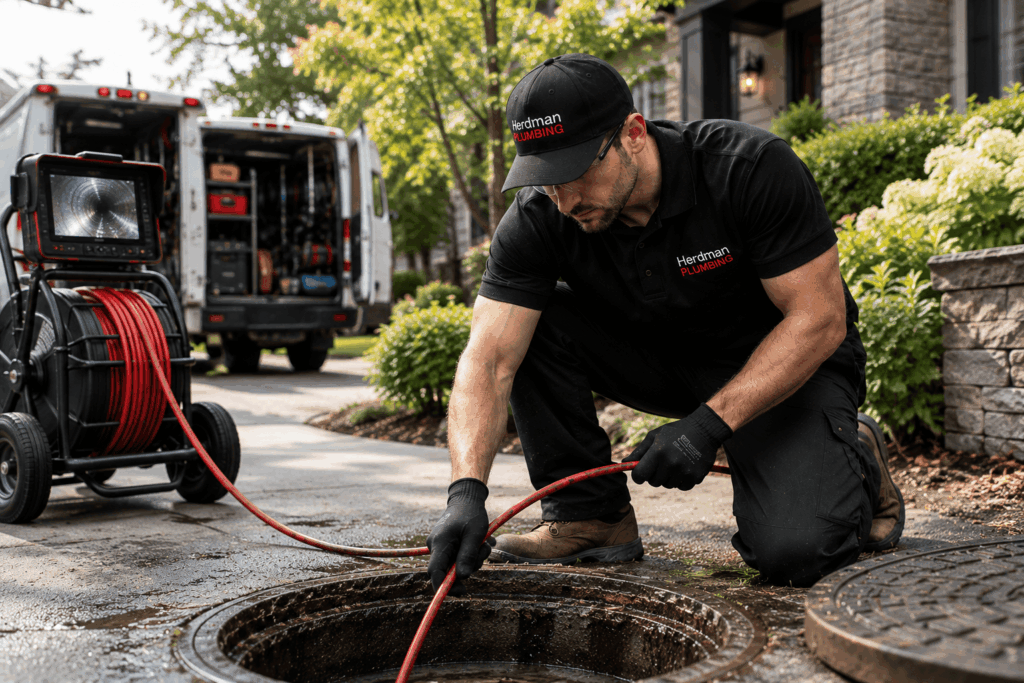
A mainline camera doesn’t just confirm something is wrong; it tells us what kind of wrong. Inspectors distinguish structural defects, like cracks and collapsed sections, from operational defects, like root masses or grease buildup restricting flow without threatening the pipe itself. A structural Grade 2 crack might sit untouched for years, while an operational blockage that looks less dramatic on screen can back up an entire home within days.
Pipe Material and Age as a Deciding Factor
Material dictates failure mode, and mode of failure dictates urgency. Crown corrosion is a common problem in homes built prior to the 1970s that use clay and concrete pipe. Hydrogen sulfide gas from wastewater is converted to sulfuric acid at the crown of the pipe, eroding the material from the inside. Interior scaling reduces the diameter of the pipe, and cast iron degrades long before a hole is formed. PVC is completely non-corrosive chemically, so a failure in a PVC line is almost always mechanical, a joint separation or installation flaw, not age-related decay.
Location of the Damage
A defect’s location changes its risk profile independent of severity. Damage near a foundation is in soil that is always moving, which speeds up crack propagation compared to the same defect near the property line where the surrounding soil is undisturbed.
Rate of Deterioration
This is the variable most homeowners never think to ask about. And it’s often the deciding one. One inspection is only a snapshot. Only when compared to a follow-up months later do you see the real trend. How long a cracked sewer line can last depends less on a crack’s current width than on whether that width is holding steady or expanding; a stable hairline crack can hold for years, while one that’s visibly widened in six months is behaving like a Grade 4 in slow motion.
A defect that hasn’t moved in two inspection cycles tells a completely different story than one that has, even if both looked identical on day one.
Signs a Sewer Repair Can Safely Wait
Genuine low-urgency defects have three characteristics in common: they are low in severity, they are not actively worsening, and they do not impair flow or watertightness. We will say so honestly when all three are true.
Minor Root Intrusion With No Blockage
Roots grow toward pipe through hydrotropism, sensing moisture escaping through joints and gaps as small as an eighth of an inch. A thin root mass that hasn’t restricted flow can typically be mechanically cleared and monitored rather than treated as an emergency.
Hairline Cracks With No Water Loss or Backup
A crack that does not allow infiltration (groundwater entry) or exfiltration (wastewater egress) is technically a recorded defect, but does not yet affect the primary operation of the system.
Cosmetic Corrosion With Structural Integrity Intact
Surface corrosion inside an older cast iron or concrete line can look severe under camera lighting without having progressed past the pipe’s protective wall thickness, a distinction inspectors measure directly rather than estimate visually.
Signs You Should Never Wait on a Sewer Repair
Certain conditions correlate so strongly with near-term failure that waiting isn’t defensible. These are the emergency sewer repair signs that move a defect straight to Grade 4 or 5 territory.
Recurring Backups or Slow Drains Throughout the House
Repeated backing up of the lowest fixtures in a home generally indicates a blockage or collapse further down the line, forcing wastewater backward into the house.
Sewage Odor Indoors or in the Yard
Hydrogen sulfide gas escaping from a compromised line presents a health hazard and generally demonstrates the pipe has lost its seal in more than one location.
Soggy or Sunken Areas of the Lawn
A sunken section of yard along the line’s path usually means the soil beneath has settled into a void created by ongoing exfiltration, the ground filling the space the pipe used to occupy.
Multiple Fixtures Backing Up at Once
Water rising in one fixture when another is used, such as a shower filling when a toilet flushes) is one of the most telling signs that you have a main line obstruction, as opposed to a simply isolated clog.
What Happens If You Wait Too Long
Left unaddressed, a Grade 2 or 3 defect doesn’t stay there. Root intrusion starts as a thin mass, but grows as roots move toward the moisture source and can eventually crack the pipe wall by internal pressure. A hairline crack with active infiltration widens as groundwater erodes the supporting soil, progressing to a fully bellied section where wastewater pools and does not flow. And a line that could have been repaired with trenchless sewer repair while the damage was still localized may progress to where full excavation is the only option, turning a sewer line repair vs replacement decision that once had two answers into one with a single, more disruptive path forward.
Beyond the pipe itself, repeated backups introduce raw sewage contact risk with every occurrence, and prolonged yard saturation can undermine nearby foundations, driveways, and hardscaping never designed to sit above saturated soil.
How to Know Which Category Your Sewer Line Falls Into
You can’t determine this from the surface; it’s simply not visible information without a camera in the line. A sewer camera inspection cost is minor compared to the cost of a Grade 4 defect being mistaken for a Grade 2 defect and allowed to run its course. That inspection is what helps homeowners in Silverdale, Poulsbo, Port Orchard, Bainbridge Island, Gig Harbor, Bremerton, and surrounding communities in Kitsap County turn an unknown into a real answer.
This blog has discussed how professional sewer assessment works: a defect grading system that distinguishes urgency from guesswork, pipe material and age that dictate how a line fails over time, and the warning signs that mean a repair really can’t wait. The line between monitoring and immediate action is not arbitrary; it is based on evidence taken directly from inside the pipe.
At Herdman Plumbing Heating & Cooling, this is the standard we hold every inspection to. Our team grades what the camera finds, weighs pipe material and deterioration rate against that grade, and gives homeowners a straight answer rather than a default push toward the most expensive option. Where trenchless methods are appropriate, we use them to limit disruption to your property; where a line has progressed past that point, we’ll explain exactly why replacement is the safer route.
If you recognize any of the warning signs above, don’t wait for the situation to answer the question for you. Call our team today at 360-698-4147 to schedule a camera inspection and find out, with certainty, which category your sewer line actually falls into.