
Most sewer failures don’t announce themselves with a burst pipe. They start small: a drain that burbles when the washing machine runs, a faint smell near one spot in the yard, a toilet that requires two flushes instead of one. These early signals are ignored all the time, and that is how a two-hour fix turns into a multi-day excavation project. Herdman Plumbing Heating & Cooling has spent nearly two decades reading these warning signs correctly before they become emergencies.
This blog breaks down exactly why sewer repair costs swing so widely between homes with seemingly similar problems. We’ll walk you through what really influences pricing, from the type of damage to the technology used to fix it, so you can understand what you’re being quoted and why.
Why Sewer Repair Costs Vary So Much
No two sewer repair jobs are priced the same, and the reason has less to do with the company doing the work and more to do with what’s physically happening underground. The scope of a project is independently affected by pipe material, damage severity, depth, soil conditions, and access.
A sewer repair estimate built on a five-minute visual guess and one built on actual diagnostic data will almost never match. The difference between them isn’t padding; it’s how much uncertainty there was in the pipe before the actual condition was known.
The Type of Sewer Problem Plays a Major Role in Cost
Sewer damage isn’t a single category of problem. The two most common problems homeowners face, but that require completely different scopes of work, are root intrusion and structural collapse. That’s why lumping “sewer repair” into one price range rarely makes sense.
Tree Root Sewer Damage: A Slow-Motion Problem
Tree root sewer damage doesn’t happen overnight. Roots are drawn to the moisture and nutrients inside a sewer line and will exploit even a hairline crack or a loose joint to get to them. Once inside, roots don’t just block flow; they continue to grow, widening the original crack until the pipe’s structural integrity is compromised. A line caught early, with roots present but the pipe still intact, is a very different repair from one where years of growth have deformed the pipe itself.
Collapsed Sewer Pipe: When Repair Becomes Replacement
A collapsed sewer pipe removes options. Once a section has caved in, there’s no lining or patch that restores function, because there’s no longer a continuous surface to work with. This is the scenario that most often pushes a project from a repair into a sewer line replacement, since the damaged section has to be physically removed or replaced rather than reinforced.
A hairline crack and a full collapse can start from the exact same root intrusion, twelve months apart.
Pipe Location Can Significantly Impact the Price
Where a line runs beneath your property changes how a crew can reach it, and that access shapes both the method and the timeline available for the repair. A shallow line in an open side yard is simple. Add a line under a driveway, mature landscaping, or next to a foundation, and you have layers of planning that most homeowners never see.
Depth brings its own complications. If it’s a deeper line, more careful shoring and support are needed to keep a work area stable, and that extra groundwork applies if the repair turns out to be excavation or trenchless.
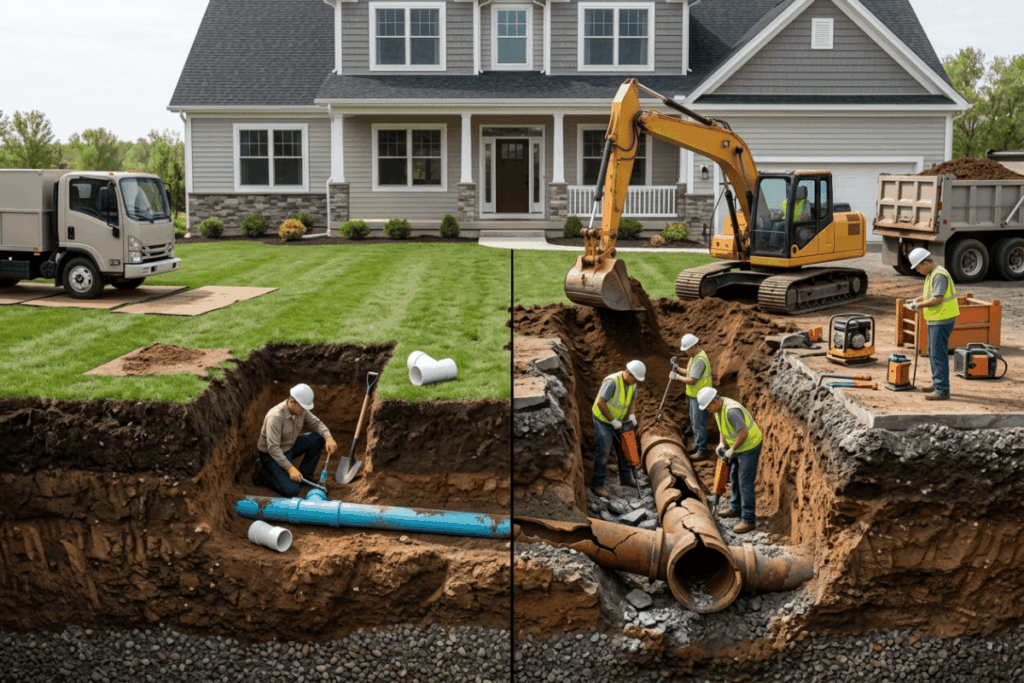
Traditional Excavation vs. Trenchless Sewer Repair
Trench-based repair used to be the only option, and it still has a place for certain failures. But for most residential lines, trenchless sewer repair is the preferred method because it fixes the same problem with a fraction of the disruption. Two techniques dominate trenchless work, and they are not interchangeable.
CIPP Lining: Reinforcing What’s Still There
Cured-in-place pipe lining is a process where a resin-coated liner is fed into the existing pipe and cured to the interior walls of the pipe, making a new pipe inside the old pipe. This method is suitable for cracks and joint separations rather than collapsed sections, because it relies on the host pipe being structurally sound enough to support the liner.
Pipe Bursting: Replacing the Line Entirely
Pipe bursting is done in a different way. A bursting head is drawn through the damaged line, breaking the old pipe outward, and at the same time pulling a new pipe into place behind it. This method is capable of dealing with severely deteriorated or collapsed sewer pipe situations that CIPP lining cannot handle, since the old pipe doesn’t need to be intact.
| Factor | CIPP Lining | Pipe Bursting |
| Best suited for | Cracks, root intrusion, sound host pipe | Collapsed or severely deteriorated pipe |
| Pipe diameter | Slightly reduced by new liner | Can match or increase original size |
| Typical turnaround | Longer, due to curing time | Often completed in a single day |
How Sewer Camera Inspections Influence Repair Costs
Before any repair method gets chosen, the pipe needs to be seen, not guessed at. A sewer camera inspection feeds a high-resolution video unit directly through the line, giving our technicians a real-time view of cracks, blockages, and root intrusion exactly where they occur.
This step avoids one of the most expensive mistakes in sewer repair: selecting a method that doesn’t fix the real problem. A line found to be sound enough for CIPP lining on camera skips the far more invasive process of pipe bursting or excavation that it may not have needed.
Why Delaying Sewer Repairs Can Increase the Final Bill
A sewer problem doesn’t stay the same size if you leave it alone. But it gets worse, and the pattern is predictable.
- A small crack lets in trace amounts of root growth.
- Roots continue expanding, forcing the crack wider.
- Flow restriction leads to recurring backups in multiple fixtures.
- The compromised section eventually fails structurally.
- What began as a targeted sewer line repair became a full sewer line replacement.
Waiting doesn’t just risk a bigger repair. It can cause water damage inside the home, standing water in the yard that can be contaminated, and repeated service calls for a symptom that keeps coming back because the source was never fixed.
How Professional Sewer Inspections Help Control Costs
A thorough sewer inspection exists to find the root cause, not just confirm that something’s wrong. That distinction is what separates a repair that lasts from one that resurfaces the same issue within a year.
Once our technicians diagnose a line, the goal is always the same: to match the repair to the actual condition of the pipe, not the easiest or most invasive assumption. That precision is what prevents a simple crack from being treated and priced as a full collapse.
Understanding Value Beyond the Initial Sewer Repair Price
The lowest quote isn’t always the better outcome. A repair that addresses the cause – whether that is aging pipe material, unresolved root intrusion, or a section beyond reinforcement- lasts much longer than a patch on a symptom. That difference means fewer callbacks and a system that actually stops failing.
What Homeowners Should Take Away This
Sewer repair pricing isn’t arbitrary. It reflects the type of damage present, where the pipe sits on the property, whether the line can be reinforced or needs to be replaced, and how much diagnostic work went into the decision. Understanding these factors turns a confusing estimate into one that makes sense.
Herdman Plumbing Heating & Cooling has served Kitsap County and the surrounding region since 2005, bringing camera diagnostics and trenchless repair technology to homeowners who need sewer repair in Silverdale, Bremerton, and Poulsbo. Our team also handles sewer repair in Port Orchard, Belfair, and Bainbridge Island, which homeowners rely on when a line shows signs of trouble. Our approach starts with seeing the actual condition of your line before recommending a fix, so the solution matches the problem rather than the other way around.
If you’re noticing slow drains, recurring clogs, or damp patches in the yard, the cost of waiting is almost always higher than the cost of calling now. Reach Herdman Plumbing Heating & Cooling at 360-698-4147 to schedule a professional sewer inspection and get a clear, accurate path forward.