
Most homeowners assume their air conditioner works hardest on the hottest day of the year, since higher temperatures should mean more strain on the system.
That’s not always what happens.
HVAC professionals regularly hear from homeowners whose systems ran fine through a heatwave, then acted up on a mild 70- to 75-degree afternoon: the house feels clammy despite the right thermostat reading, rooms cool unevenly, and the unit cycles on and off more than it should.
An air conditioner never responds to outdoor temperature alone. It also responds to indoor humidity, thermostat signals, airflow, insulation, and cycle length, and moderate weather tends to reveal small performance issues that remain hidden during extreme heat.
For homeowners across Silverdale, Bremerton, Port Orchard, Poulsbo, Bainbridge Island, and the surrounding Kitsap County area, this explains why an AC that seems to be “working” can still leave rooms uncomfortable, and why a professional assessment of air conditioner performance is worth doing before a full breakdown occurs.
Did you know? Heating and cooling account for roughly 43% of the energy used in the average American home, according to the U.S. Department of Energy, making HVAC performance one of the biggest factors behind comfort and utility costs.
Shouldn’t Hot Weather Be Tougher on Your Air Conditioner?
At first glance, that seems like the obvious answer, but the way an air conditioner actually operates tells a different story. During extreme heat, the system settles into longer, steadier cycles that keep the evaporator coil cold enough to remove real moisture from the air while maintaining a consistent temperature.
Moderate weather changes that pattern. The thermostat reaches its target faster, so the system shuts off before finishing the cooling and dehumidifying process, and instead of long, efficient runs, it starts and stops throughout the day. That’s usually where comfort problems start.
| Plumbing Emergency | What We Typically Find |
| Burst pipe | Freezing temperatures, aging materials, or excess pressure |
| Overflowing toilet | Drain blockage or a restriction further down the line |
| Clogged drain emergency | Grease buildup or debris that’s piled up over time |
| Water heater leak | Worn valves or a tank on its way out |
| Sudden drop in pressure | A hidden leak somewhere in the system |
Quick Tip: If your home feels humid despite the thermostat reading being right, the thermostat probably isn’t the problem. Your air conditioner likely isn’t running long enough to pull out the excess moisture.
What Happens Inside Your Air Conditioner on Mild Days?
Every time the unit starts, several parts kick in at once: the thermostat sends a signal, the compressor circulates refrigerant, the evaporator coil pulls heat from the indoor air, the blower pushes it through the ductwork, and the condenser releases that heat outside. On a moderately warm day, the thermostat can be satisfied before enough moisture has left the air, so the home reaches the right temperature on paper while still feeling sticky.
Why run time matters
- Think of it like an oven switched off before the food finishes cooking.
- The oven technically did its job; it just didn’t run long enough to finish it.
- A shorter cooling cycle affects cooling system performance in much the same way.
- It can lower the temperature without ever completing the moisture removal required to make indoor air feel genuinely comfortable.
- Over time, this pattern is exactly what routine AC maintenance is meant to catch before it becomes a bigger issue.
Why Short Cycling Becomes More Noticeable During Moderate Temperatures
One of the most common issues technicians encounter during HVAC troubleshooting is short cycling, in which the system turns on, runs briefly, then shuts off before completing a full cycle. Repeated cycling chips away at comfort and air conditioner efficiency, often due to oversized equipment, dirty filters, refrigerant issues, airflow restrictions, thermostat problems, or electrical faults.
Signs your system may be short cycling
| What You Notice | What It Usually Means |
| Unit starts every few minutes | Cycle is ending too early |
| Rooms never feel consistently comfortable | Airflow or sizing issue |
| Indoor humidity stays high | Moisture isn’t being removed |
| Energy bills climb unexpectedly | System is working harder for less result |
| Unit sounds louder than normal | Frequent starts are straining components |
Government Statistic: ENERGY STAR notes that proper maintenance of heating and cooling equipment can improve efficiency and cut down on unnecessary energy use.
The Often-Overlooked Role of Indoor Humidity
Ask most homeowners what makes a room feel comfortable, and temperature is usually the first answer, but humidity deserves just as much credit. Air holding too much moisture feels warmer than it is, which is why 75°F in one home can feel less comfortable than the same reading elsewhere. An air conditioner handles two jobs at once, lowering temperature and pulling out moisture, and when cycles run too short, only the first job gets finished.
| Balanced Humidity | Excess Indoor Humidity |
| Comfortable indoor air | Sticky, damp conditions |
| Better sleep | Restless nights |
| Consistent cooling | Rooms feel warmer than the thermostat reading |
| Fewer thermostat adjustments | Frequent temperature changes |
| Stronger overall cooling system performance | Home never quite feels comfortable |
The U.S. Environmental Protection Agency notes that keeping indoor humidity between 30% and 50% helps improve comfort.
For homeowners looking into air conditioner repair in Silverdale, Bremerton, or Bainbridge Island, persistent humidity is often the earliest sign that a system needs attention.
When 75°F Feels Less Comfortable Than 90°F
It sounds like a contradiction, but plenty of homeowners say a mild afternoon feels less comfortable than a full heatwave. Outdoor temperature isn’t always the best measure of indoor comfort, since insulation, ductwork, humidity, airflow, and sun exposure all play a role, and uneven airflow or a short cooling cycle makes room-to-room differences easier to notice.
Older homes throughout Kitsap County often deal with their own version of this: leaky ductwork, settled insulation, or restricted airflow, none of which stop the AC from running, but all of which chip away at comfort.
Signs your cooling system may need attention
- Certain rooms always run warmer than others.
- The air feels damp even after the thermostat hits its target.
- The system starts and stops frequently.
- Energy bills climb without a clear reason.
- Your AC is not cooling properly despite changes to the thermostat.
- Airflow feels weaker from some vents than others.
Quick Comfort Check: Sometimes the issue isn’t that your AC can’t cool your home. It’s that the system isn’t running long enough, or efficiently enough, to keep temperature and humidity balanced in every room.
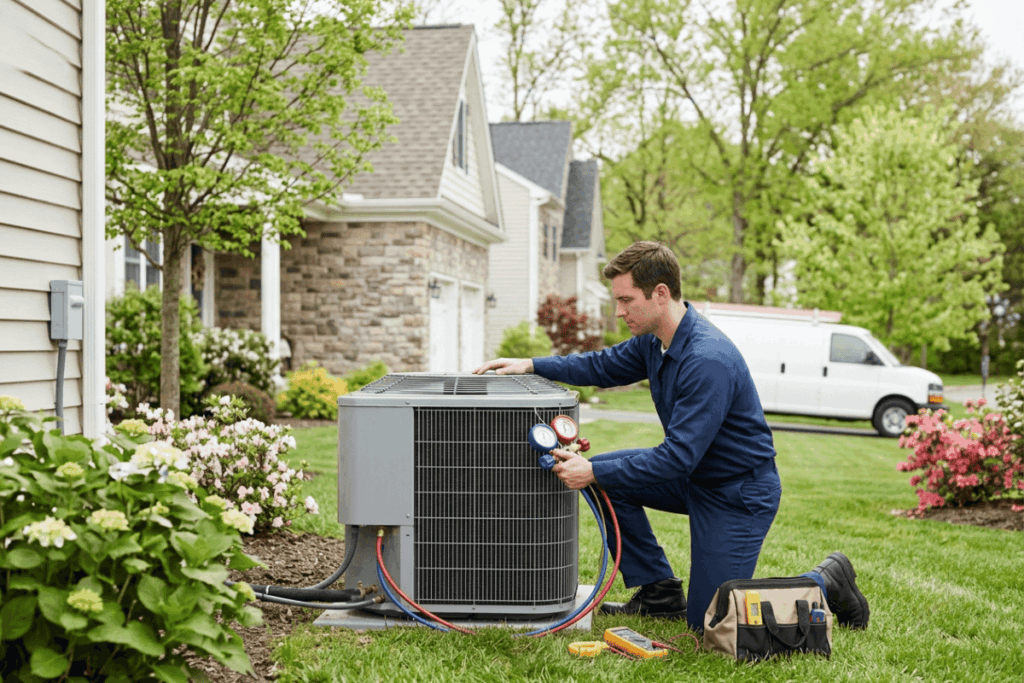
What HVAC Technicians Evaluate During an AC Performance Inspection
An experienced technician won’t rely on a single reading. A full evaluation looks at how the whole system works together.
| Inspection Area | Why It Matters |
| Air filter condition | Restricted airflow reduces efficiency |
| Thermostat operation | Incorrect readings can throw off cooling cycles |
| Refrigerant levels | Low refrigerant limits cooling capacity |
| Electrical components | Helps catch worn or failing parts early |
| Condensate drain | Keeps moisture draining properly |
| Indoor and outdoor coils | Dirty coils reduce overall performance |
| Blower operation | Supports even airflow throughout the home |
| Overall system operation | Confirms reliable performance |
That level of detail distinguishes normal seasonal behavior from an issue that calls for air conditioner repair. Regular maintenance, according to the U.S. Department of Energy, can improve equipment efficiency and help a system last longer overall.
Practical Ways to Improve AC Performance During Mild Weather
Not every cooling headache means a repair bill or a whole new system. A little upkeep, mixed with a few smart habits, can go surprisingly far:
- Get your AC serviced before the summer heat hits.
- Swap filters out on your manufacturer’s suggested schedule.
- Keep your outdoor unit free from leaves and debris.
- Don’t let furniture or curtains block your supply vents.
- Have the thermostat checked if readings seem inconsistent.
- Schedule an inspection if short cycling becomes more frequent.
None of this replaces a professional look when something’s genuinely off. If problems persist despite regular upkeep, worn components or aging equipment could be behind the drop in performance, and homeowners researching air conditioning repair in Port Orchard, Bremerton, Bainbridge Island, or Silverdale often find that catching issues early keeps small problems from turning into bigger repairs later in the summer.
Older systems nearing the end of their service life are a different conversation. Options like air conditioning replacement or installation are worth exploring, since properly sized equipment and a professional installation matter just as much as the unit itself, and the same holds true for anyone weighing air conditioning installation in places like Bremerton, WA.
Looking Beyond the Thermostat for Better Comfort
Outdoor temperature only tells part of the story. Humidity, airflow, thermostat accuracy, system sizing, and overall equipment condition all factor into how a home actually feels, which is exactly how an air conditioner can seem to be running fine while a few rooms still feel warm, sticky, or just off.
At Herdman Plumbing Heating & Cooling, every cooling evaluation starts with the whole system rather than a single symptom. Our team handles professional HVAC service for homeowners across Silverdale, Bremerton, Port Orchard, Poulsbo, Bainbridge Island, and the surrounding Kitsap County area, helping pinpoint what’s actually going on and getting comfort back on track. If your AC isn’t cooling properly or a few rooms just never feel right, reach out to us at 360-698-4147 to get it looked at.